
Kite blog
The Perfect Storm: Why the PRN Market Has Come Under Unprecedented Pressure in 2026
The UK packaging recycling evidence market has experienced one of its most challenging years in its history.
A combination of fundamental regulatory changes, tighter accreditation requirements and serious problems with the introduction of a new digital reporting system has significantly disrupted the supply of Packaging Recycling Notes (PRNs) and Packaging Export Recycling Notes (PERNs), driving price pressure across all six packaging materials.

These pressures have now become sufficiently serious for Defra and the Environment Agency to intervene, issuing a Regulatory Position Statement (RPS) 383 on 9 October 2026.
For producers, the key message is this is not simply a case of normal market volatility.
The rules governing how recycling evidence is generated, verified and issued have fundamentally changed, creating challenges that were not fully anticipated when the UK's recycling targets were established.
New restrictions on PERN issuance, more demanding accreditation requirements and disruption to the digital evidence system have meant that legitimate recycling activity has not always translated into the generation and availability of PRNs and PERNs.
In short, recycling is continuing to take place, but the system for generating the evidence needed to demonstrate compliance has encountered significant transitional difficulties.
RPS 383: An Exceptional Response to Ease the Pressure on the PRN Market
The publication of RPS 383 on 9 October 2026 represents an important acknowledgement of the exceptional compliance challenges facing the market.
Recognising these difficulties, the Environment Agency has introduced a temporary enforcement position for the 2026 compliance year, providing some welcome relief for three particularly pressured materials: Steel, Plastic and Wood.
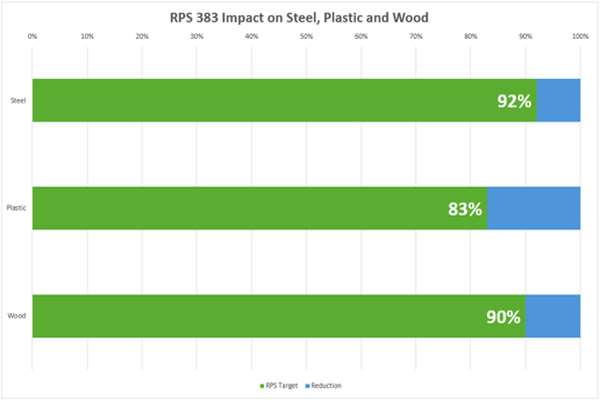
Although statutory recycling obligations remain unchanged, under RPS 383 the Environment Agency will not normally take enforcement action against eligible Producers and Compliance Schemes in England, provided they satisfy the conditions of the RPS, including securing evidence covering at least:
- 92% of their Steel P(E)RN obligation
- 83% of their Plastic P(E)RN obligation
- 90% of their Wood P(E)RN obligation
Full statutory obligations continue to apply to all the other packaging materials.
Importantly, Defra has encouraged Compliance Schemes and Producers to operate within the spirit of the RPS, recognising that its effectiveness depends on responsible and proportionate behaviour across the market.
Central to this is the expectation that the actions of individual Schemes and Producers should not adversely affect the ability of others to meet their compliance obligations.
The intention is to ease pressure on an already constrained market, rather than intensify competition for scarce evidence through unnecessary purchasing.
What This Means for Our Members
We will be adopting the spirit of RPS 383 in our approach to securing evidence and managing our Members' compliance obligations in 2026.
For Members with Steel, Plastic and Wood obligations, this provides a valuable opportunity to achieve meaningful reductions in evidence purchasing costs, helping to mitigate the financial impact of the exceptionally high PRN prices seen this year.
By applying the enforcement thresholds set out in RPS 383, rather than automatically purchasing evidence to cover 100% of the statutory obligations, we expect to reduce the volume of PRNs and PERNs we need to purchase on behalf of our Members, with a corresponding reduction in evidence purchasing costs.
This approach should also help ease demand for scarce evidence, reducing unnecessary competition and supporting a more balanced market for all obligated Producers.
This is not about stepping away from environmental responsibilities. It is about recognising the practical challenges facing the market, avoiding unnecessary costs for our Members and ensuring our actions do not disadvantage other Producers seeking to meet their obligations.
Our focus remains on securing the evidence our Members need, managing their compliance costs as carefully as possible, and continuing to work with Defra and the regulators to help address the challenges of implementing the still relatively new pEPR framework.
We will embrace the spirit of RPS 383, act responsibly in the wider interests of the market and ensure that where possible, our Members benefit financially from reducing evidence purchasing costs.
